
Why Mental Health Awareness in Yoga Matters
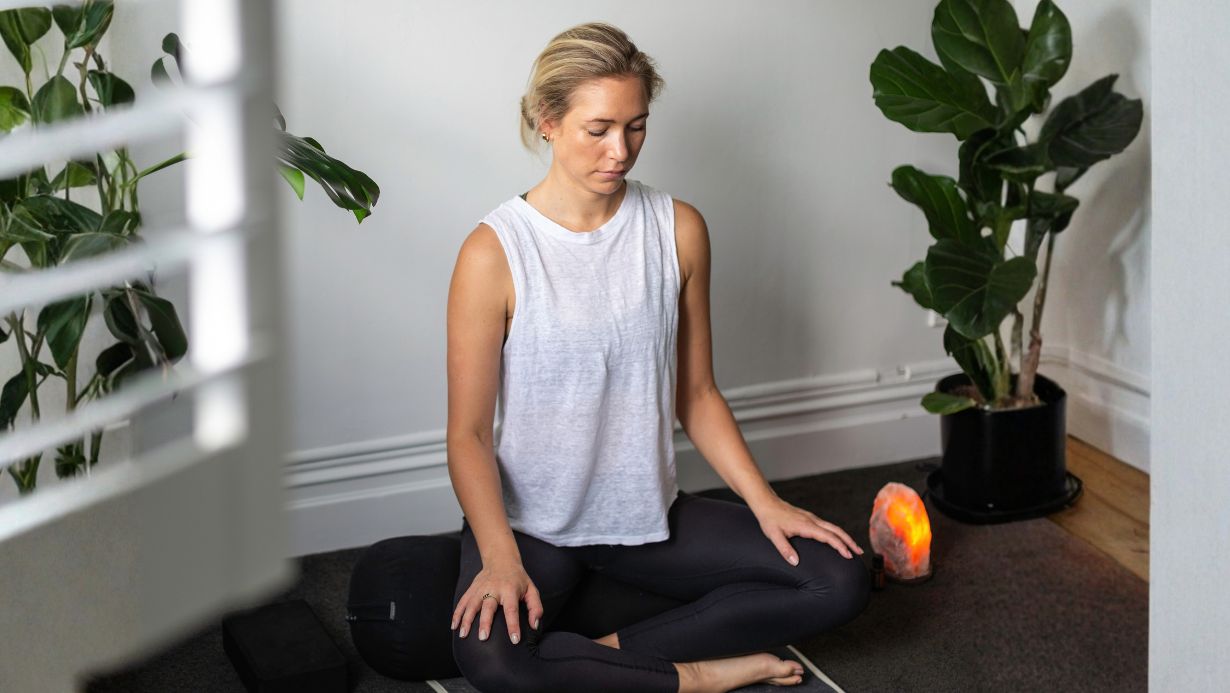
That’s part of why it can be genuinely supportive for some students navigating mental health challenges or carrying a history of trauma.
That said, it isn’t always safe or supportive.
When mental health awareness or trauma-informed principles aren’t part of how a class is taught, yoga can unintentionally cause harm, reinforcing disconnection from the body, activating nervous system dysregulation, or leaving a student feeling exposed and misunderstood in a space they came to for support.
Most teachers are well-intentioned, I genuinely believe that, but if you’ve lived with your own mental health experience or a trauma history, you can usually tell pretty quickly when a class isn’t being taught through a trauma-informed lens.
Why Trust Is Already in the Room
This matters because students walk into a yoga space with a real sense of trust, even if it’s never said out loud, and there’s an expectation that the teacher knows how to hold that space safely.
When that safety isn’t there, students can end up feeling more alone or more unsafe in their own body than they did before the class started, and sometimes that means they don’t come back to yoga at all, even though it might have been exactly what they needed.
The Power of Language
Language is one of the most powerful tools we have as teachers. The words we choose can help someone feel more at ease and embodied, or they can trigger shame, pressure, or a sense of not being enough.
Phrases like ‘just relax’ or ‘breathe through it’ sound supportive on the surface, but for someone whose nervous system is dysregulated, in hypervigilance or shutdown, those cues can land as invalidating rather than helpful.
Trauma-aware teaching tends to sound different, leaning invitational rather than instructional, with things like ‘if it feels okay for you today,’ or ‘you’re welcome to skip this or take another shape,’ or ‘see how this feels and adjust in whatever way you need.’
These are small shifts in language, but they matter because they hand agency back to the student, and that sense of agency is essential for nervous system safety and regulation.
Beyond Words: How the Whole Class Is Held
Safety isn’t only about tone or wording, though, it’s about how the whole class is held, and predictability matters just as much as giving people real permission to opt out of a pose, modify, leave the room, move at their own pace, or keep their eyes open if that feels safer.
This is what allows people to stay within their window of tolerance, that range where the nervous system can stay regulated enough to actually engage, reflect, and feel present rather than just survive the class.
Knowing Your Scope
Part of creating that safety is also being honest about your role.
It’s worth remembering that yoga teachers aren’t therapists, psychologists, or crisis support workers, even if at times we end up wearing something close to that hat, and we don’t need to be.
The most ethical teachers I know are the ones who understand exactly where their training ends and stay inside that line, which means not offering psychological advice, not making emotional assessments or diagnoses, referring out when it’s needed, and being willing to say, ‘This isn’t something I’m the right person to support you with right now.’
That, too, is part of holding safe, boundaried space.
What This Makes Possible
When yoga is taught through a trauma-aware, mental health-informed lens, it becomes something genuinely respectful, letting people show up exactly as they are, with no pressure to perform, fix, or change anything.
It supports nervous system regulation, builds self-trust, and can help someone feel more connected to their body again, and for some people, it ends up working alongside therapy or other support, helping ease symptoms of anxiety, depression, Posttraumatic Stress Disorder (PTSD), or stress.
Yoga doesn’t need to be perfect to be healing, but it does need to be safe, and that’s something we get to actively create as teachers, not just through our words and how we sequence a class, but through our willingness to keep learning, to stay inside our scope, and to hold a steady, genuine commitment to letting our students show up as they are.
References
Clark, C. J., Miller, N. J., Stansbury, J. P., et al. (2021). Consent and compliance: The
impact of social pressure in helping professions. Trauma, Violence, & Abuse, 22(4),
889–901.

She is trained in Mental Health Aware Yoga, Trauma-Sensitive Yoga and iRest Yoga Nidra, bringing a trauma-informed lens to her teaching and her clinical work.
FOR THE SEEKERS
COMMUNITY

FREE EBOOK

The information provided on this blog is intended for informational purposes only and should not be considered professional advice.
Please consult a qualified healthcare professional for personalised guidance or come and join one of our programs for professional training.
Any statements, claims or endorsements expressed by our guest authors, speakers and podcast sponsors are solely their own and do not necessarily reflect the views or opinions of Mental Health Aware Yoga and the Yoga Psychology Institute.
MENTAL HEALTH AWARE YOGA
Ready to support your students' mental health with confidence, compassion and skill?
Join the hybrid training in Mullumbimby Australia. Start the online component today, then join us in-person on 17-18th October 2026.
Or join us for the online training starting the 16th of September instead.
MORE BLOG POSTS

What Mental Health Aware Yoga Taught Me About My Own Burnout
Completing the Mental Health Aware Yoga training was a deeply meaningful experience for me. I had already experienced...
On Turning Inward, Mental Health and Yoga with Dr Lauren Tober
Think of the last time you were so absorbed in something that the world fell away. A good book. Hands in the garden....
On Asana, Pranayama, Mental Health and Yoga with Dr Lauren Tober
Ask most people what yoga is, and they'll picture the postures. Maybe the breathing. And fair enough, it's what we...
BLOG CATEGORIES

Western Psychology

Yoga Psychology

Safe Container

Therapeutic Skills

Yoga Practices

Mental Health Crisis
JOIN OUR ONLINE SANGA
Are you on Facebook?
Awesome, so are we!
Come and join our brilliant community of like-mind Yoga Teachers and tune into (mostly) weekly video episodes with our founder Dr Lauren Tober.
It's all happening over in our FREE Facebook group.


MEET OUR FOUNDER
Hi, I'm Dr Lauren Tober!
As a Clinical Psychologist and Yoga Teacher of nearly two decades and the author of Mental Health Aware Yoga: A Guide for Yoga Teachers, I'm passionate about integrating yoga and psychology on the mat, in the counselling room and in the world.
With the growing interest in mental health and yoga, yoga students are attending yoga classes for the mental health benefits in unprecedented numbers.
In fact, 79.4% of yoga students report practicing yoga for the mental health benefits.
It's important that Yoga Teachers know how to support them.
I'm glad you're here.
LET'S STAY CONNECTED
Be the first to hear about online and world wide in-person trainings BEFORE registration opens
Receive your invitation to join our closed Mental Health Aware Yoga Facebook group for teachers
Download the Patañjali's Eight Limbs of Mental Health Aware Yoga ebook by Dr Lauren Tober